Monday, March 28, 2011

Bassano 1796, AAR #5

Here's the latest pictures & update from the Bassano game. Enjoy!


A close up of my main objective

A closer view of the unsuccessful cavalry charge

The cavalry retreats, but they delayed just long enough

The Infantry then goes in. Notice the first set of hedgerows were sucessfully removed by the engineers

A closer view with Horse Artillery support

The Austrians prepare defensive positions around Bassano
 
A view of the Austrian BUA in the center being bypassed by the Left Flank and assaulted as well

The Infantry assault is successful as hedgerows disappear

The enemy adds in more troops
 
My troops across the river are charged and form square

The Left Flank finally breaks through and is on to Bassano

The BUA in the center is attacked vigorously

A flank attack is conducted on the BUA as well

More hedgerows are destroyed along with enemy units

The Austrians move back and regroup

The BUA is starting to fall
 
The Center holds as the Left Flank advances "En Avant"!

The most innovative Napoleonic game I’ve ever seen!

St. Lucia 1807


A Battle Report by Joe Dever

This is a fictitious Napoleonic action between British and French forces, set on the Caribbean island of St. Lucia in the year 1807.


035: Castries – viewed from the east. The French fleet is less than two miles distant.

I’ve got to say,  this recent posting on the Wargames Society forum depicts one of the nicest innovative Napoleonic games I’ve ever seen!  You can see the many photos of this fascinating game that Joe Dever has posted here:  

http://ilovewargameing.21.forumer.com/viewtopic.php?t=3286

This game epitomizes how some prefer to see Napoleonic wargaming: small actions; lots of color; fantasy and fun; beautiful and exotic scenery; a storyline; silly names; odd little units; plenty of goings on, and the merging of both land-based and sea-going action.


Some gamers preferences are different from what many (maybe most) other Napoleonic fans prefer, who tend to go for larger, more realistic and tidier games. But, as they say, vive la différence!


Anyway, congratulations to Joe Dever and his mates for posting these pictures of their inspiring game onto the Wargames Society forum.

Sunday, March 20, 2011

Bassano 1796, AAR #4

Austrian artillery comes up in support as more Austrians try to reinforce & hold Bassano

Some Austrians move into Bassano others come up to reinforce the Left Flank forces

Close up!

My forces and reinforcements press the attack. The Master plan is to take out the vineyards to allow a flank attack on Bassano

The Cavalry charges the guns, as units enter the woods to flush out the Jagers and cross the river to support the Left Flank and threaten Austrian reinforcements!
 
My forces successfully cross the river and reinforcements start to threaten the Austrian Center built up area (BUA).

Close up of the river action!

The Austrian Center reinforcements get nervous and react

The cavalry goes in and fails, but distracts the Austrians long enough for engineers to start clearing vines

The Austrian Left gets nervous after the cavalry charge and reacts with light infantry & cavalry

Close up!
 
The Austrian infantry retreats while the cavalry comes out of Bassano
 
The French Left Flank engages and sucessfully bypasses the BUA in the Center

Bassano 1796, AAR #3


The initial French move (My forces on the Right Flank bypass the Austrian center)

The mighty General Brian overlooks the first French assault (Left Flank)

The Austrians use the vineyards as defensive cover (You bastards!)

Additional Austrian forces head to the built up areas

Sneaky Austrian Jagers cover the woods while Artillery sights down the main road also

My forces make initial contact with the enemy

My forces advance down the shallow river bed (Sneaky Bastards as well)

My reinforcements move up to press the Austrian Center and Right Flank

The French and Austrian Center exchange blows as the French far Left Flank enjoys the mountainous terrain

The Austrians try to sneak reinforcements to their Center built up area along with Cavalry support

Tuesday, March 15, 2011

Bassano 1796, AAR #2


Date8 September 1796
LocationBassano, Venetia, present-day Italy
ResultFrench victory


Belligerents
France First French RepublicHabsburg Monarchy Habsburg Austria
Commanders and leaders
Napoleon BonaparteDagobert von Wurmser
Strength
20,00011,000
Casualties and losses
400 killed, wounded or missing600 killed or wounded,
2,000-4,000 captured,
30 cannons, 8 standards,
200 vehicles

    
    The church of San Giovanni on the outskirts of Bassano, Bonaparte's headquarters during the battle.
    
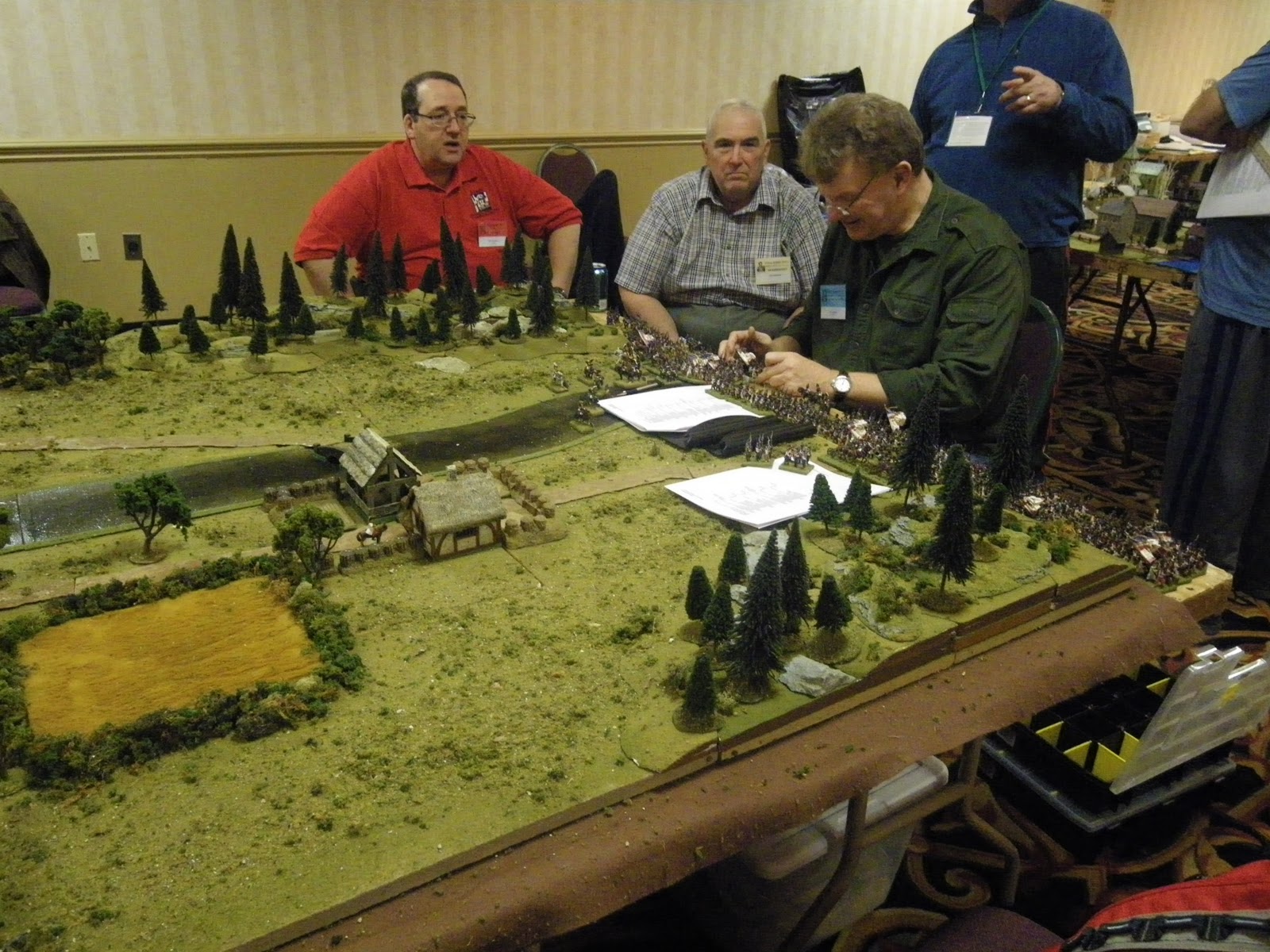
    The participants look over the scenario & terrain (Initial deployments)
    
     (Initial deployments) The Austrians rear (Units were supposed to exit here)
      
    Note the Town (L) & stronghold to the (R) initially held by the Austrians
     
    The GM (Tom G) and the French consult prior to action
     
    A view from the French perspective (More troops but less maneuver room)
    
    The GM walks softly, but carries a big stick (Points out the critical vineyards)
    
    The Austrian Left Flank forces (My enemy)!
    
    The Austrians devise their planned defensive strategy
    
    The French listen and prepare their offensive strategy (Note the river running directly down the center of the board)
    
    NEW EUREKA FRENCH LEGERE

    COLD WARS 2011, Battle of Bassano, 8 September 1796 AAR

    PEL Listing; 

    NAP - Battle of Bassano, 1796: Event F-139; 28mm 6 PM [GMs Tom Garnett/Rob Walter]


    The Battle of Bassano:


    Was fought on 8 September 1796, during the French Revolutionary Wars, in the territory of the Republic of Venice, between a French army under Napoleon Bonaparte and Austrian forces led by Count Dagobert von Wurmser. The battle ended in a French victory. The Austrians abandoned their artillery and baggage, losing supplies, cannons, and battle standards to the French. This engagement occurred during the second Austrian relief attempt of the Siege of Mantua.


    Geography


    In 1796, there were only three practicable routes between Trento and the Po River basin. The first route lay west of Lake Garda. The second route was the road down the Adige valley east of Lake Garda and north of Verona. The third route went east through Levico Terme and Borgo Valsugana, then followed the Brenta River valley (Valsugana) southward to Bassano del Grappa. An army that held both Trento and Bassano could move troops and supplies between the two places free from French interference.


    Background:

    Austrian Plans

    The first relief of Mantua failed at the battles of Lonato and Castiglione in early August. The defeat caused Wurmser to retreat north up the Adige River valley. Meanwhile, the French reinvested the Austrian garrison of Mantua.


    Ordered by Emperor Francis II to relieve Mantua at once, Feldmarschall Wurmser and his new chief-of-staff Feldmarschal-Leutnant (FML) Franz von Lauer drew up a strategy. Leaving FML Paul Davidovich and 13,700 soldiers to defend Trento and the approaches to the Tyrol, Wurmser directed two divisions east then south down the Brenta valley. When he joined the large division of Johann Mészáros at Bassano, he would have 20,000 men. From Bassano, Wurmser would move on Mantua, while Davidovich probed the enemy defenses from the north, looking for a favorable opportunity to support his superior. Lauer predicted that the French, having suffered recent losses, would be unable to react in time. Unknown to the Austrians, the French government desired that General Bonaparte cross the Alps to join the army of General Jean Moreau in southern Germany.


    Fench Plans


    Bonaparte posted General of Division (MG) Claude Vaubois with 10,000 men on the west side of Lake Garda. MG André Masséna defended the Adige River valley with 13,000 troops and MG Pierre Augereau covered Verona with 10,000 more. MG Charles Kilmaine maintained the blockade of Mantua with MG Jean Sahuguet's division of 8,000 soldiers and held a 2,000 man reserve at Verona.
    Bonaparte struck first, sending Masséna and Augereau north toward Trento. Meanwhile, Vaubois advanced past Lake Idro to Riva at the north end of Lake Garda. Vaubois and Masséna converged on Rovereto on the Adige. At the Battle of Rovereto on 4 September, the French routed Davidovich's outnumbered troops, inflicting 3,000 casualties at a cost of 750 killed and wounded.


    Finding that Wurmser had moved toward Bassano, Bonaparte abandoned the plan to link with Moreau. Leaving Vaubois to observe the fleeing Austrians in the upper Adige valley, the French army commander decided to take a bold but risky course of action. Cutting loose from his supply line, he ordered Augereau, followed by Masséna, to the east into the Brenta valley. On 7 September, Augereau's 8,200 soldiers overwhelmed the 4,000 Austrians of Wurmser's rear guard at Primolano (6 km north of Cismon del Grappa), capturing 1,500 men. The victorious French then followed the valley as it turned south toward Bassano.


    Battle of Bassano
    Part of the French Revolutionary War
    Chiesa copy.jpg
    The church of San Giovanni on the outskirts of Bassano, Bonaparte's headquarters during the battle
    Date8 September 1796
    LocationBassanoVenetia, present-day Italy
    ResultFrench victory
    Belligerents
    France First French RepublicHabsburg Monarchy Habsburg Austria
    Commanders and leaders
    Napoleon BonaparteDagobert von Wurmser
    Strength
    20,00011,000
    Casualties and losses
    400 killed, wounded or missing600 killed or wounded,
    2,000-4,000 captured,
    30 cannons, 8 standards,

    Forces:

    Austrian Army

    FM Dagobert von Wurmser (43,000 available)

    • Main Army: Wurmser (19,348)
    • Corps: FML Paul Davidovich (13,695, not including Loudon and Graffen)
    • Mantua Garrison: Joseph Canto de Irles (17,259, fit for duty: 10,271)
      • Brigade: GM Ferdinand Minckwitz (6 bns)
      • Brigade: GM Leberecht Spiegel (4 bns)
      • Brigade: OB Sola (3 bns)
      • Brigade: OB Sturioni (4 bns, 4 sqns)
      • Brigade: OB Philipp Brentano (6 bns)

    French Army

    Historical Information:


    The battle of Bassano (8 September 1796) was a French victory won at the point where the River Brenta emerged from its mountain valley onto the plains north-west of Venice, and which ended the second Austrian attempt to lift the siege of Mantua. That attempt had begun at the start of September when Field Marshal Würmser led two divisions down the Brenta valley from Trento. His aim was to join up with a third division (General Mészáros) at Bassano, and then turn south-west towards Legnago and Mantua.


    At exactly the same time Napoleon had begun an advance up the Adige valley, heading for Germany to join up with the Army of the Rhine. When he reached Trento Napoleon discovered Würmser's plan. Rather than retrace his steps down the Adige valley, Napoleon decide to follow Würmser down the Brenta, taking advantage of his army's superior speed to catch him. One French division (Vaubois) was left around Trento to watch Davidovich's covering army.


    Surprised by the speed of the French advance, Wurmser was only able to gather up 11,000 men before the collision took place.


    On 8 September, 20,000 French soldiers fell upon Wurmser from the north. First, they attacked the 3,800-man Austrian rearguard under FML Peter Quasdanovich and General-Major (GM) Adam Bajalics. Bonaparte sent Masséna down the west bank of the Brenta and Augereau down the east bank. Overwhelmed by repeated attacks and pursued by Colonel Joachim Murat's cavalry, the rearguard collapsed and Bajalics was captured. Wurmser deployed one brigade on the west bank, a second brigade on the east bank, and a third brigade in Bassano. Colonel Jean Lannes led a successful charge which broke the Austrian lines and burst into the town. Quasdanovich later assumed command over the defeated Austrians who retreated east, but 3,500 soldiers of FML Karl Sebottendorf's division fell back to the south with their army commander.


    The French suffered 400 killed, wounded, and missing. Wurmser lost 600 killed and wounded. Between 2,000 and 4,000 Austrians, eight colors and 30 artillery pieces were captured. The vigorous French pursuit also seized a bridging train plus 200 limbers and ammunition wagons.


    Austrian Relief of Mantua, 1796-97;


    By the end of 6 September the Austrians were badly strung out. Mészáros had been sent ahead to Vicenza, Sebottendorf's division was at Bassano, and Quosdanovich was at Primolano, fourteen miles inside the mountains. Early on the next day Napoleon's leading units caught up with Quosdanovich (battle of Primolano, 7 September 1796), taking several hundred prisoners. After this first success the French spent the rest of the day completing their march through the mountains, and on the morning of 8 September they were ready to attack the Austrian positions around Bassano.

    When Würmser discovered that Napoleon was close behind him he decided to continue his march towards Vicenza. Quosdanovich and General Adam Bajalich were left behind to cover the approaches to Bassano, taking up positions about a mile upstream of the town, just at the start of the high ground. Behind them the river curves around to the west, with Bassano on the east bank.
    At dawn on 8 September the French advanced down both banks of the river,
    Masséna on the western (right) bank and Augereau on the eastern (left) bank. Both French attacks were successful. Masséna forced Bajalich back to the bridge at Bassano, splitting the Austrian force in two. Augereau forced his way into the town, where the Austrian retreat turned chaotic. Quosdanovich was forced to retreat east to Treviso, while Würmser and the larger part of the army escaped south west to Vicenza.

    The French claimed to have taken 5,000 prisoners at Bassano, probably more Austrians than had actually been involved. On the day before the battle Würmser's merged army had been 20,000 strong. Six days later he reached Mantua with around 12,000 men. 1,700-2,000 had been left at Legnago, and a larger force escaped with Quosdanovich, suggesting that the figure was somewhat lower, but even so Napoleon had taken at least 3,000 prisoners, split the Austrian army in two, and foiled the second Austrian attempt to lift the siege of Mantua.

    In the aftermath of the battle Würmser managed to reach safety at Mantua, despite pausing for a day at Legnago. On 14-15 September he turned and fought another battle outside the defences (
    battle of San Giorgio), but was defeated again and had to take refuge inside the besieged city.

    Monday, March 7, 2011

    COLD WARS 2011! Here we come.


    If you are going to Cold Wars and want to play in Tom Garnett's WFR Bassano game on Friday night at 6pm in the Distelfink room let me know? I have attached pictures of the battlefield which just looks amazing. Tom runs a great game using the Carnage & Glory rule system. A few people have already committed and there is room for a couple more.


    28mm Russian Infantry 1799

    Rob Walter from EUREKA Miniatures, U.S.A. states;

    I have received about 60% of the Fr. Legere. For those that have already sent me your orders I have pulled the figures you requested that have arrived. The problem is I have not been able to complete any of the orders as the figures I have received have only been from series one & two. Codes WFR80-88 and the mounted figures have not arrived. I expect the rest of the Legere to be here in the next two weeks. If you make it to Cold Wars I will have some of those available  for sale.

    I also have attached a new pdf from Eureka describing Suvarov's Russian army from 1799. I think John Chadderton (Eureka Australia) has done a great job on this pdf. rivaling the one he did for the Cossacks. Expect more of these as we progress in the range. 
    cheers,
    Rob
    Eureka Miniatures USA

    Carnage&GloryII
     
    FALL IN 2010


    FALL IN AAR;


    http://www.carnageandgloryii.com/

    As usual I'll post AAR's of all my games and rules sets played at the convention and will sneak some pictures of the French Legere and post here this weekend! See you there;


    Chris